Current Project
COMPACT DEUTERON ACCELERATOR TO PRODUCE NEUTRONS FOR TRANSMUTATION OF USED NUCLEAR WASTE
Omega-P’s compact neutron source
What’s the problem we aim to solve?
Over 80,000 metric tons of used nuclear waste is now stored at power reactor sites across the US. The used fuel contains partially-spent uranium and plutonium that can be chemically separated and recycled into fuel. It also includes unstable isotopes such as americium, neptunium, and curium with radioactive decay times of 100’s of thousands years. Geological repositories, such as at Yucca Mountain, have neither the capacity nor broad public support to offer even temporary storage. The widely stored long-lived nuclear waste at reactor sites is viewed as a serious public health risk and a potential terrorist threat. A pathway towards reducing the lifetimes of stored unstable isotopes from used fuel is essential as a practical matter and as a way to strengthen public support for nuclear power. Our pathway towards that goal is outlined in this brief pamphlet.
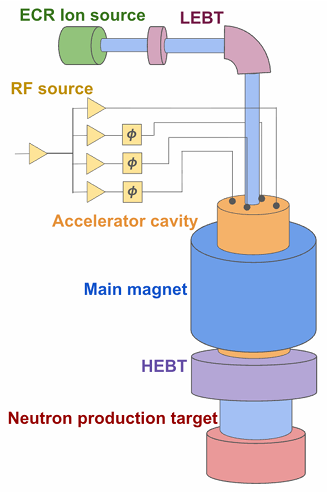
What’s the status of our Proof of Concept dCARA design?
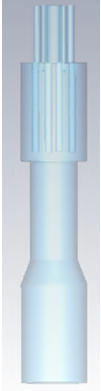
Our patented concept for dCARA lies in its use of a TEM rotating mode quarter-wave cavity immersed in a resonant axial magnetic field as the accelerator structure. It uses four off-axis rods, as shown at the right, that support and shape fields in the center of the structure. A low energy (60 keV) beam is injected at the top, and the high-energy (40 MeV) beam emerges at the bottom. Dimensions for the prototype structure we plan to build are 1.0m length and 0.7m diameter. These allow the structure to fit within the warm bore of a superconducting solenoid. Four RF couplers excite a rotating symmetric TEM mode. Beam dynamics simulation results on this structure are shown on the following page. Operating at 75 MHz with an axial magnetic field of 10T, the results show that an injected 140 mA 60-keV deuteron beam can be accelerated to 40 MeV with an efficiency of 70%.
Aren’t there already means to solve it?
Current approaches to eliminate or at least reduce hazardous risk from long-lived isotopes in used nuclear waste can be categorized as either encapsulation with burial, or transmutation via neutron spallation to create isotopes with much shorter decay times, e.g. 300 vs 300,000 years. That approach, discussed for over three decades, relies on spallation of neutrons when energetic protons impinge on a high-Z target: i.e., a 1-GeV proton beam on a tungsten target could produce up to 50 spallation neutrons per proton. In some scenarios, the target for transmutation is surrounded by a sub-critical nuclear fuel assembly which, when a relatively small number of spallation neutrons is added, can reach criticality to allow nuclear fission and become a power source—a reactor with the safety virtue of being able to be switched off by simply turning off the proton beam. Concepts using spallation neutrons are often labeled Accelerator Driven Systems (ADS). A prominent example is the Spallation Neutron Source (SNS) at Oak Ridge National Laboratory, with scores of research users. SNS employs a 1 GeV, 1.4 mA, 100-m long superconducting linac. Its proton beam impinges on a liquid mercury spallation target. The cost to build SNS beginning in 1996 was $1.4 billion equivalent to $2.9 billion in 2026. That significant cost may be a major barrier that has prevented ADS’s from being built in the US, although tentative work is underway on comparable versions at several institutions.
Why is our approach transformative?
The heart of our approach is the highly-compact accelerator dCARA which is designed to produce a high-current 40-MeV deuteron beam in a single one-meter long cavity. Neutron production using this beam is not via spallation, but rather deuteron breakup, yielding a neutron energy spectrum centered at about 20 MeV, and rates of production in the range up to 8 x 10¹⁶ sec-1. While the neutron energy spectrum from breakup is not dissimilar from that produced with SNS GeV-scale proton spallation, the production ratio is smaller by up to a factor-of-10. This deficiency is offset by the much higher deuteron current, smaller footprint (few m2), and cost (ca. $50M) of a dCARA-based neutron source. Investment for an SNS-scale neutron source ranges up to several billion USD. Dependence on such a large single costly SNS-like machine for transmutation of the entire stockpile of used nuclear fuel may pose undue risk, as compared with our approach that would deploy, say, a dozen much smaller cheaper dCARA-based sources. Design of dCARA-based neutron sources could evolve in time, with improvements based on operating experience.
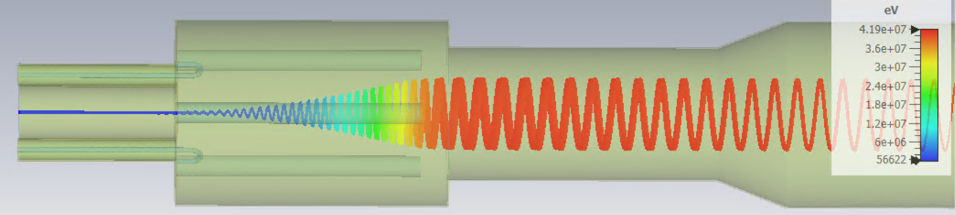
The blue-to-red spiral curve in the simulation result at the right is a trace of the trajectory and energy gain of a short beam segment. This result, obtained with CST-Studio, is proof of the validity of our design concept, with high-current un-bunched acceleration without beam breakup or beam reflection, insofar as a simulation can be taken as a reliable prediction of actual performance. A high-energy beam transport line (not shown) within which the beam will travel down to the deuteron breakup target, from which the neutrons will emerge, uses a reverse magnetic field to convert most of the particles’ momentum from transverse to longitudinal. Consequently, the beam will sweep automatically over a large and adjustable area, thereby diluting the specific power density that the target must sustain, and thus eliminating any need for a separate scanning or rastering device.
How far along are we expecting to be in three years towards a Proof of Concept design?
During the three years from the start of the ARPA-E project, we expect to have a fully-optimized engineering design ready for follow-on construction and testing for a neutron source employing a low duty-factor up to 40-MeV, 25 mA dCARA. The optimization shall include details of the cavity structure to minimize Ohmic wall losses and wall interception of deuterons. The magnetic field profile will be optimized to maintain good beam quality, minimum beam energy spread, and minimum magnet system length. The low-energy and high-energy beam transport lines shall provide good beam matching. The design shall be based on operating parameters of proven ion and RF sources, and on the magnetic system—all from vendors which have already built comparable components. Experimental validation of cavity performance at a moderate power level may be carried out at Particle Accelerator Research Foundation (PARF), where a 175 kW pulsed 75 MHz amplifier is expected to be available for our use by the end of 2027.
What’s needed to achieve a full Proof of Concept demonstration?
Proof-of-Concept low-duty demonstration can be achieved when the following requirements are met;
Availability of a Test Facility (such as PARF) that is licensed by State and Federal Radiation Safety authorities to run at low-duty with production of 40-MeV deuteron and/or proton beams.
Operating parameters for the Test Facility that are a good match to those required for dCARA.
Sufficient funding for 5-year operations, and for acquisition by PARF of test-stand components and infrastructure as needed for dCARA and a deuteron break-up target.
What’s needed to achieve a full-scale Prototype demonstration?
The main differences between full-scale Proof- of-Concept and full-scale Prototype demonstrations are low-duty vs high-duty operation, and an upgrade to radiation safety licenses. As with any multi-MW accelerator system, heat transfer can be a major engineering challenge. With our 7-MW system and 70% efficiency, 2 MW must be dissipated from heating of cavity surfaces while 5 MW would need to be dissipated at the break-up target and in a moderator needed to slow the neutrons. These challenges are probably best met in collaboration with an industrial partner, inquiries from which will be welcome.